Racial Elements in The Revenant

      In today’s pop culture Alejandro Iñárntu star studded movie The Revenant was something that all of Hollywood knew was going to be a motion picture that would redefine cinematography and shed light to America’s brutal upbringing.The Revenant though set back in the 1820s underlying meaning of nature vs mankind and how manifest destiny was portrayed as going against nature and even as a racial binary. We see this in the way Alejandro shoots this film and having long shots in a scene of nature and landscape picturesquely almost like a painting.The racial binary is shown mostly through the interactions Glass has with Fitzgerald and the Europeans interactions with the Natives, but can also be analyzed with visual elements when comparing a still of the film to the painting American Progress. The comparison of these two paintings can help audience see the difference between views of manifest destiny and how it was racial and the affects to nature it has.        
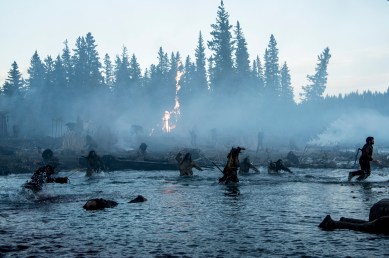
the-revenant-4b        In this scene we have the natives facing off against the Europeans trying to take the pelts that the fur traders have. This shot in the film is picturesque like so that calls for some visual analysis relating to how the racial binary of setting the Europeans against the Natives harms nature going against the peace and beauty that nature holds. In the picture viewers can see the trees in the background being illuminated, highlighting nature’s beauty, and how harmonious it is. The binary of this racial divide is shown through the flames that are setting off in the middle of the trees, showing how disruptive and chaotic this fighting is to nature. I also think it’s kind of interesting to note that in this picture everyone seems topicture-of-manifest-destiny-american-progress-2 be going to the right in a frantic way. We have Natives chasing a European man, throwing their weapon in him but viewers are able to see a completely different narrative in the painting American Progress. The people in this painting are all moving to the west representing Manifest destiny, walking over in a calm manner following an angelic figure, in a way justifying the move and saying it’s a good thing, the Natives also move in that direction but are seen moving in a more hasty way almost looking like they’re going to be trapped.
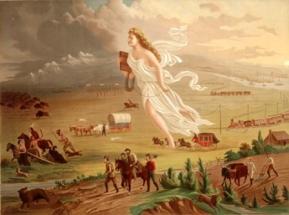
       The comparison in this picture to the one from The Revenant is one to note because the two pictures when compared to one another show the different scenarios that were taking place within the same time period. In the American progress painting we have bright hues giving the feeling of a bright future while the parts still inhabited by the natives are darker. In the still from The Revenant is dark though when shooting this movie Alejandro Iñárritu choose only to use natural lighting still doesn’t disregard the fact that this still is darker in the fighting area to show how what is happening isn’t beautiful but violent. The figures almost black give the audience the contrast of man and nature because they are being illuminated by the trees in the background but the fact that they’re still dark shows how this racial binary it is not a harmonious aspect of nature.
Pleasurable Destruction

       The sensation of pleasure humans feel when looking at… Ruins? This is called ruin porn. Why is it called this, and why isn’t it even a phrase might be someone’s first thought after hearing such a phrase, it surely was mine. So why is it a phrase used in academic language, simply because it is a way to describe the social aspect of people trying to understand an emotional feeling people get from observing ruins, and the fear of the chaos that they come from. Which is weird because ruins basically represent the death and destruction of a distant society which should be disturbing and unnerving to observe. Thinking of a time that was once there and the people and social structures, so people are receiving pleasure from looking at destruction. This makes sense to me in the world we live in today, we have tons of action movies, war movies, and superhero movies that all emphasis the destruction that occurs within those realities and they dominate the box office because people enjoy watching those things come to play on the big screen, and seeing how in the end a majority of a time from those destructions come rebirth, and a better society from the one destroyed. So in the end people who enjoy looking at ruins and partaking in seeing ruin porn, observe and learn from those fallen societies what worked and things that didn’t work, to use in their own or a new society.

       Another thing I feel like may influence the way people perceive the word ruin porn negatively is simply because of the connotation of the word porn. The negative connotation with porn goes far back in our history, and something I think can even be pulled from the bible, “But I say to you that everyone who looks at a woman with lustful intent has already committed adultery with her in his heart”(Matthew 5:28), porn is basically looking at predominantly naked women or women in an inappropriate manner, which is what is being said and looked down upon by God. We see this sense of women and nakedness being taboo in the book of Genesis with Adam and Eve. Because like Adam and Eve who were at first innocent not even recognizing their nakedness tricked into eating the fruit from the tree of knowledge of good and evil, they all of a sudden feel shameful and even like it’s a taboo. And this notion of shame and taboos I feel like is introduced and prevalent in the world from which “they created”. The thought of porn has the very close association of taboo and it goes to show with Adam and Eve that once we become knowledgeable about norms and cultures taboos are quickly picked up and recognized as so. So why is ruin porn not seen as Taboo in the academic sphere of knowledge?

       From my understanding and analysis of the words and their meanings, ruin porn is a term used in a manner not to showcase taboos of the pleasure people get from staring at ruins but how society as a whole is captivated by this phrase that represents something so negative and destructive as a way to be helpful and improve our societies. Even the recognition of how the word porn and its original connotation being negative, from something as old as the bible and now it is being used in academic language shows the progress and change in norms in our society from then to know.

CNN article “What ‘ruin porn’ tells us about ruins”

The Circle of The Inevitable End

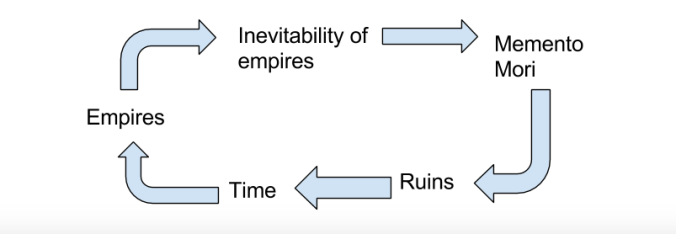
       Empires, the symbol of power and the definite sign of greatness was something that people in societies like the Romans believed was divine and the want of the Gods. But like people, empires have a lifeline and eventually cease to exist only in the form of ruins. Ruins are the bones left of an empire after that society falls in whichever way it did so, when looking at them from a historical point of view ruins can be a symbol for the inevitability of empires and a reminder of death. In this blog I want to talk about how ruins in paintings can be associated to memento mori and how they represent the inevitability of empires which relates to the concept of time coming in full circle to relate back to empires. It’s important to recognize the relationship each concept has with the other because it helps us get a better understanding of society and the way human essence is important to humans.

       The first concepts we can connect in the circle is ruins in the form of memento mori in paintings. Memento mori in paintings is usually an object or objects used to remind viewers of the inevitability of death. It usually also places an emphasis on the emptiness of the world so we can focus on what is next after life. To me this basically sums up what a physical ruin can stand for. Ruins are the remains of societies and structures left by the passing of humans and their man made social constructs and structures. Ruins make people who view them think of what happened to the thousands of people who walked through those empires, and where did they go? Ruins in paintings represent those deaths of the citizens of those empire and the death of the structures and social construct the rulers created. Ruins are like bones left behind and memento mori is shown through bones, tombstones, and mirrors so the two concepts coincide.

       Then these two concepts of ruins showing memento mori help weave in the concept of the inevitability of empires being ruined. Since memento mori is the reminder of the inevitability of death which is what ruins depict, and ruins come from empires! So if we work backwards to connect these things together we can see how because ruins are reminders of death and the death of a society (memento mori), we have to now what are ruins which were empires. This also helps us bring in the concept of time, because the inevitability of ruins shows the passing of time. Essentially I’m trying to say that when empires are created they are inevitably going to fall which ties into memento mori and ruins because they are what empires become death, they remind us of death and the passing of time is shown throughout all of it. In painting we can also visualize time in ruins when painters paint things like vines and new life formed where old life used to inhabitat, which shows the grand cycle of life where in the death of one thing can come life of another like nature and plants.

       In the end all of this information that I shoved in your brain is important because it shows how society acknowledges the fact that things in this world aren’t meant to last forever. With the reminder of death with memento mori humans focus on what’s next (human essence) they try to build things like empires as a way to have something to outlast them when they die and the cycle of empires to ruins to new beginnings goes in circle.screen-shot-2016-11-28-at-11-54-32-am