To Choose or Not?

Connections from past and present are always a recurring theme in our history. A problem in our history that always happens to be a problem is the treatment of women and the lack of choices and power over one’s own body they have. Women have always been put in a position of submission by men, in lectures throughout the quarter we have discussed the implications of women in various time periods and cultures. Recently our focus has been on Iranian women and their lack of control over how they should dress their own bodies. We see this lack of choice for women all across the world even in our culture in the U.S. were women reproductive rights are on the line. Though U.S. and Iranian culture are completely different they both show the over step of government into women’s personal lives and how these choices made by men restrict our freedoms.

  From my understandings of lecture and present knowledge of Iranian women’s dress has and still is under the control of the government and is enforced by officers. In their culture Iranian women must conceal their bodies in loose fitting clothing that cover their arms and all of their legs down to their ankles. Though for many years women had become accustomed and comfortable with their required dressings, in 1936 the Pahlavi dress code was enforced which banned women from wearing their normal required dressings and chador. This enforcement was thought to help make the nation become more progressive but it’s safe to say it was to fall into the western ideals that ultimately we’re trying to push out Islamic influences on the country.

Though these dress codes seem that they would’ve gave women more freedoms it did the opposite for most since most women had already grew comfortable with there dressings being forced to expose themselves was something that they didn’t want to do. Because of these dress codes most older women didn’t leave the house which shows how these forms of laws in fact do restrict women’s freedoms. Though it might seem to outsiders and people who don’t understand the culture that being able to wear western styled clothes is a freedom for these women it wasn’t because of their association and comfort of their regulated dressings. The fact of the matter is that women who aren’t given the right to choose for themselves will feel subjugated to how laws and men want the women of their society to behave and look.


Damaging Effects of a Model Minority Status

Asian Americans in the U.S. are now facing a new hurdle as a minority group, being referred to as the “model minority”. This term not only harms Asian Americans by pitting them

images

Time Magizine, August 31, 1987. Cover by Ted Thai

against other minority groups but also changes the way we see Asian Americans in the country. Though being called a model minority is a racial stereotype that can be seen as positive rather than most racial stereotypes, it still has its burdens and
negative connotations.

This “model minority” stereotype that Asian Americans have been forced open has not only created this image of Asian Americans being the ideal minority but also puts stress and pressure on top of the individual Asian American. Because of this stereotype that Asian Americans are book smart, driven, and also are successful in their life, has created this pressure for them to always be their best. Especially for Asian American students who struggle in school will have usually isolate themselves and not ask for the help they need. Being this model minority and not ones to complain, cause attention or problems to themselves, is usually hard to combat these racist remarks towards them.

White America has a long history of painting a picture on minority groups that they feel don’t represent the ideal American lifestyle. This can be seen with African Americans who were painted as rapists and thugs, and even todays Muslim population that are seen as terrorists and threats to our nation’s security. Asian Americans also shared the burden of these narratives that white Americans produce, and were seen as rapists. Asian Americans finally were able to assimilate and were able to benefit from capitalist America. Since they are a hard working people being able to produce and contribute has always been something Asians have given America from the railroads to city’s infrastructures.

The catch to this stereotype is that this “model minority” should not be taken as a compliment but as another way for white America to reinforce a racial social hierarchy. During the civil rights era when black communities resisted segregation and became more assertive in their fight, white Americans turned their eyes to Asian Americans, and questioned why other minorities groups couldn’t be like the Asian AMericans, hardworking with no complaints. This only distanced Asian Americans from other minority groups, since they were showcased on how minorities should behave, in American society. This was simply due to the fact that white Americans at the time couldn’t realize that though both groups are minority people, Asian Americans had not faced systematic dehumanization for hundreds of years the way African Americans had experienced in America.

The term “model minority” is not something to be held as a positive attribute for the Asian American community. This racially dividing term not only harms the way other people view Asian Americans as a minority group but also the high standards that we’ve placed on Asian Americans and how they try to hold themselves up to. This term is only another way to divide minority groups and pit them against each other, but through recognition of each other’s communities struggle, there can be better understanding and better relationships within all communities.

References; The Professional Burdens of Being a “Model Minority” – ‘Model Minority’ Myth Again Used As A Racial Wedge Between Asians And Blacks

The Other Side of History

Growing up we are all taught of the great pioneers and explorers of America’s history, and their greatest accomplishments that shaped our nation. But teachers aren’t or weren’t actually providing the full truths of our history, and the people who’ve forged this country to what it now is. The tales of the pilgrims, Columbus, George Washington and even our beloved Pocahontas are simply not all truthful and just simply not properly told. Why is it taught to us wrongly when we are young to only be stripped down to its truth when we get older? Wouldn’t it be simpler and the most logical thing to just tell their stories right the first time? Maybe it has to do with not trying to taint such important figures and holidays in American culture. I mean who would like to stand up everyday and recite the Pledge of Allegiance speaking of liberty and justice for all, knowing that our forefathers took part in our most horrific history of slavery. Maybe the underlying reasons for these things are shame.

When teaching young children who are so new and pure to knowledge do we really want to face them with the ugly truths that children like themselves were being taken from their families and sold across the oceans to work the rest of their lives knowing that they’ll never have a future, or that children their age were being raped by people intruding on their homelands. Doesn’t seem right, so might as well paint a pretty picture in their minds let them cut out little pilgrim hats and pretend that the Indians and pilgrims were best friends.

The other side to history is darker, the true side to history is a mix of cultural misunderstandings and ignorance of morality. The encounters that indigenous people shared with their European intruders not only were cultural misunderstanding in addition to the European idea that European values were ordained and were the right beliefs. Is there still this belief of a “white man’s burden”, but instead of feeling the burden of being more civilized and feeling the responsibility to teach people, it’s now the actual burden of those past implications that were thought to be “helping” people. And the shame in those actions that are leading people to misinform people on true events. In the wake of ignorance media nowadays is playing their part in reinforcing the actual events and actions that our ancestors went through.

With the media’s help in telling stories like that of 12 Years A Slave, or even The Revenant, it gives Americans a better sense of what this country was truly founded on. Wouldn’t you want to know the truth of your history to ensure that we don’t repeat the past unknowingly? Why of course, and fortunately with social media films and other forms of media it is easier than ever to correct these inaccurate tellings of our history. 5382225_orig.jpg

History’s Resistance to Empire

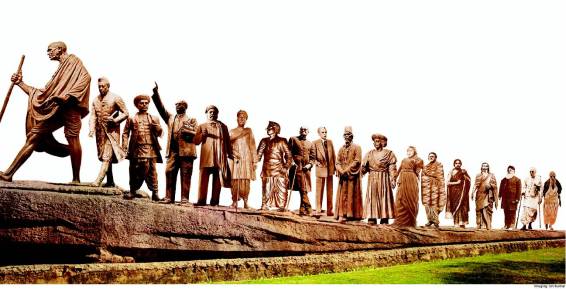
indian-leaders.jpgFrom lectures we were told of the importance language plays in the resistance and building of Empires. But from that we were able to realize that history plays a big role in the resistance of strengthening of an empire, both lectures Chaturvedi and O’Toole were able to shed light on the importance history has on empire. Yet both lectures had a different outlook on the responsibilities that history writers have to the world. HIstory writing is not only a way to release your burdens the way Nehru saw it but a way to fulfil the patriotic historians call that is vital is when resisting Empire.
Professor O’Toole had a different look on history then that of Chaturvedi’s, instead of seeing the importance of personal accounts, she saw the importance through history through primary sources, such as Del La Vega or the Martin Chambi photos. For O’Toole is wasn’t about the inner disputes and inner challenges that the individual felt towards Empire that both Gandhi and Savarkar felt. But the collective groups that we’re able to get there resistance told and documented as a primary source.

From Chaturvedi’s lectures he described history as something essential to understanding what it is going on in the future and being able to experience and then tell that history is vital in order of understanding the resistance. Chaturvedi discusses political historian and revolutionist Savarkar, who believed in the “Patriotic Historian”, and how it is the duty of the people to not be a slave to history. From this view of an active history Chaturvedi and Savarkar I believe are trying to make  the people feel motivated and the sense of urgency to act for their own futures. When Savarkar says “master and not slave to history”, he was calling for his Indian nation to not sit idle to the British Empire and take back their India.

In the Nehru text history is seen as a way to relieve ones burdens, and shows these problems that you’ve been facing to the world so they can understand too. Nehru states, “By writing about the past I have tried to rid myself of the burden of the past”, by this Nehru sees the relief that comes from writing your past. Writing about the past also allows you to recognize what’s going on in your life and helps make a clear picture to what that is, so when realising your self of the burdens of the past you’re allowing yourself to get a clear sense of what is happening in the future.

History from all perspectives is yet another form of resistance to Empire. From both of the understanding of Nehru and Savarkar history is a way to get people to know your side the past and how it’s affected you and why acting on this information alone is important. Chaturvedi’s and O’Tooles notion of history may be different but they both present and active history that must be saved and discussed for the future generations.

Resistance: The Fight Continues (edited)

In my last blog I discussed the ways in which Indigenous people of the Andes and Inca empire were able to successfully transform themselves into colonial elites and profited from colonization and a new empire. In this blog I want to focus on how resistance to empires have evolved from what they used to be, using the indigenous people of Peru as may comparison. Progressing to modern day resistance, seen through the Standing Rock resistance happening in North Dakota or even political resistance shown towards Donald Trump by U.S. citizens out protesting, and how resistance has now become a norm and easily distributed worldwide through media and the development of technology.

In Peru during the 1780s a rebellion lead by Tupac Amaru against the Spanish was out in full force. This rebellion is important to note due to the fact that though this rebellion was against the Spanish empire, Tupac Amaru did not want to leave the empire but fix the colonial corruption that was occurring at the time, fighting for more and better Native representation in decision making that affect their lives. We see this almost constantly  today in the U.S., minority groups wanting better representation and going out and protesting.

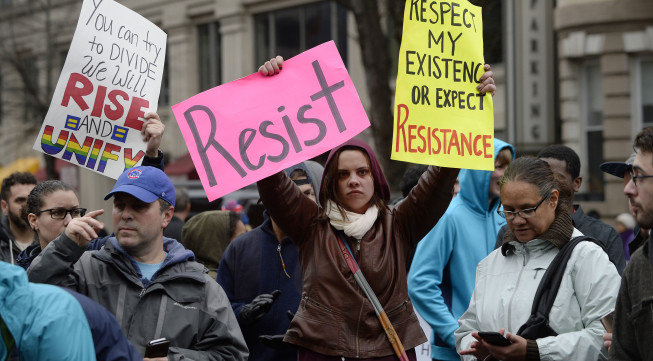
Protesters, rally in the streets of Washington to disrupt inauguration - DC

Protesters block K street to try to disrupt the inauguration of President Donald Trump on January 20, 2017 in Washington, DC..Photo by Olivier Douliery/Abaca(Sipa via AP Images)

The Women’s March on Washington would be an example of minority groups going out in the world and showing resistance to the government. The Women’s March occurred as backlash to the inauguration of new president Trump and in order to send a message to the new administration the women’s right are as vital as human rights This was even mentioned on the campaign trail by Hillary Clinton stating, “Reproductive rights are human rights”, which was something then nominee Trump strongly disagreed with. President Trump on his campaign trail spoke of defunding Planned Parenthood which to most women was seen as an act against women and their right to care for their bodies as they want/need.

The Women’s March on Washington resembles that of the Tupac Amaru Rebellion because in both instances minority groups are standing up to their governments and demanding that their groups be recognized and treated equally and fairly. The need for resistance since those of the 1780s have only grown bigger and have become well known and world renowned. Unlike the days of Tupac Amaru and those innovative Incan systems that made them such a powerful empire, the modern day person now has access to so much more technology then ever before making something like the Women’s March in Washington able to be watched and engaged in all the way from Peru!

Technological advances that we have in 2017 have helped allow resistance movements such as the Women’s March become more of a world collaboration of different countries and people. This global involvement is something that the Inca unfortunately were not able to use in their resistance. But for modern day it has increased participation and the means of which people can participate, through twitter facebook, and any other social media outlet, we are now able to post and share our messages such as the Women’s March and get the whole world involved.

Resistance has not disappeared but have become something so usual and regular in places across the world including the U.S.. Looking at resistances from the past and the present helps us understand that fighting for what is right is never going to end especially in these cases of minority people being discriminated and mistreated. Resistance has grown and will continue to grow as technological advances help issues become more publicized and problems within governments keep occurring, the people will rise up to the call of resistance.

Resistance: The Fight Continues

In my last blog I discussed the ways in which Indigenous people of the Andes and Inca empire were able to successfully transform themselves into colonial elites and profited from colonization and a new empire. In this blog I want to focus on how resistance to empires have evolved from what they used to be, looking back at those indigenous people of Peru. Progressing to modern day resistance, which can be seen through the Standing Rock resistance happening in North Dakota or even political resistance shown towards Donald Trump by U.S. citizens out protesting, and how resistance has now become a norm and easily distributed worldwide through media.

In Peru during the 1780s a rebellion lead by Tupac Amaru against the Spanish was out in full force, this rebellion is important to note due to the fact that though this rebellion was against the Spanish empire, Tupac Amaru didn’t want to leave the empire but fix the colonial corruption that was occurring at the time and fighting for more and better Native representation when making decisions that would ultimately affect their lives. The U.S. also faced issues of minority groups wanting better representation and going out and protesting.

 The Women’s March on Washington would be an example of minority groups going out in the world and  resisting to the government. The Women’s March occurred as backlash to the inauguration of new president Trump and in order to send a message to the new administration the women’s right are as vital as human rights. President Trump on his campaign trail spoke of defunding Planned Parenthood which to most women was seen as an act against women and their right to care for their bodies as they want/need.

Protesters, rally in the streets of Washington to disrupt inauguration - DC

Protesters block K street to try to disrupt the inauguration of President Donald Trump on January 20, 2017 in Washington, DC..Photo by Olivier Douliery/Abaca(Sipa via AP Images)

The Women’s March on Washington resembles that of the Tupac Amaru Rebellion because in both instances minority groups are standing up to their governments and demanding that their groups be recognized and treated equally and fairly. The need for resistance since those of the 1750s have only grown bigger and have become well known and world renowned. Unlike the days of Tupac Amaru and those innovative Incan systems that made them such a powerful empire, the modern day person now has access to so much technology that something like the Women’s March in Washington can be seen in Peru!

Resistance has not disappeared but have become something so usual and regular in places across the world including the U.S.. Looking at resistances from the past and the present helps us understand that fighting for what is right is never going to end especially in these cases of minority people being discriminated and mistreated. Resistance has grown and will continue to grow while we have these problems within governments and peoples feel that they are not being represented and treated fairly.

Women’s March on Washington: Highlights | NBC News

https://youtu.be/6K7I6WWea4Q

Colonial Change of the Elite Inca

title-of-arms-copy-17th-cent.jpeg                                                                              Title of arms granted to Gonzalo Uchu Hualpa and Felipe Tupac Inca Yupanqui
      The Incan Empire, can be questioned to be one of the greatest empires of all time to some historians. The Incan Empire, in 1572 and its native people were to undergo the changes that colonization ultimately brings about when empires are conquered. The Incan Empire could be held to the standard of greatest empire by the fact of how intricate their administrative, hierarchy, and military system were set up, which were introduced and then used by the Spanish Empire.

      Incan hierarchy was defined by the clothing that the elites of the Incas would wear, shown through a uncu or even mascapaycha. These two pieces of clothing could show just how important you were in this hierarchy by the intricate designs on an unco because it showed that you had the money to have poeple spend such time and cumbi on you. When the Spanish conquered the Incas, the Incan and Andean people could tell that the Spanish were not the same they looked different and even smelled different from them. Noticing that the Spanish don’t have clothing as ornate as their beloved uncus, and just simply looked like commoners. But the Spanish did rely on the institutions that the Inca already had in place, such as mita, and by doing this the Spanish used the local indigenous elites to facilitate the Spanish colonial rule.

       The Inca then adopted and adapted their colonial rule, as a way to intertwine Inca into the structure of the Spanish Empire. This painting of Gonzalo Uchu Hualpa, and the coat of arms of Felipe Tupac Inca Yupanqui show how the Spanish empire allowed those indigenous elites to profit from the colonization. The Spanish Empire entrusting these elites gave them the authority and power to show the indigenous people that the Inca are still here but are changing into a colonial Inca. These paintings show this claim in the utter fact that these elites had their painting painted, which was a Spanish custom. Secondly we see the uncu representing the Inca empire and how they have that dual authority in the colonial Spanish empire and with the indigenous Incan people that understand the hierarchical aspect of the uncu.

       Lastly the coat of arms depicted in both pictures have symbolism by itself of the change of native elite Inca to the colonial elite Inca. On the left half of this coat of arms we have things that would be associated with the Spanish Empire, amour and a castle. Then as we go to the right side we have depictions of things that would be associated with the Incan Empire such as; the mascapaycha surrounded by serpents with crowns also known as a amaru which represented a destroyer to the Incans. Then below it we have references to the Andes with a rainbow, eagle, and a puma. Representation of the native culture is important, because it shows the indigenous people that these elites are still Inca.  

       In summation the elite Incas placed to power by the Spanish Empire did more than just facilitate the wants and need of colonialism. But showed the indigenous Inca and Andean people that the Spanish Empire was being profited off of in power and influence to these elites. Telling the indigenous people through their paintings, uncus, and coat of arms that the Inca is still here but just adapting to the colonial Inca.

Assimilation Into The Borderlands

       Being of Native American/Hispanic decent and not being familiar with both of my cultures and only really taught the basics of Native and Mexican  history it’s hard growing up not feeling like you belong with in your culture, and even harder when it feels like the U.S. government doesn’t even care for those peoples. Assimilation created this drift and seclusion from one’s own culture, and was used exactly for that purpose by white Americans in the early 1800s. The borderlands created by assimilation left many people within those cultures stuck in a in between, not feeling like they belong with Native/Hispanics but neither feel fully Americanized. The feeling of what the “American” is has taken a new form from that era there’s a new acceptance for the many cultures and ethnicities so why do we still feel these borderlands in our society?

assimilation

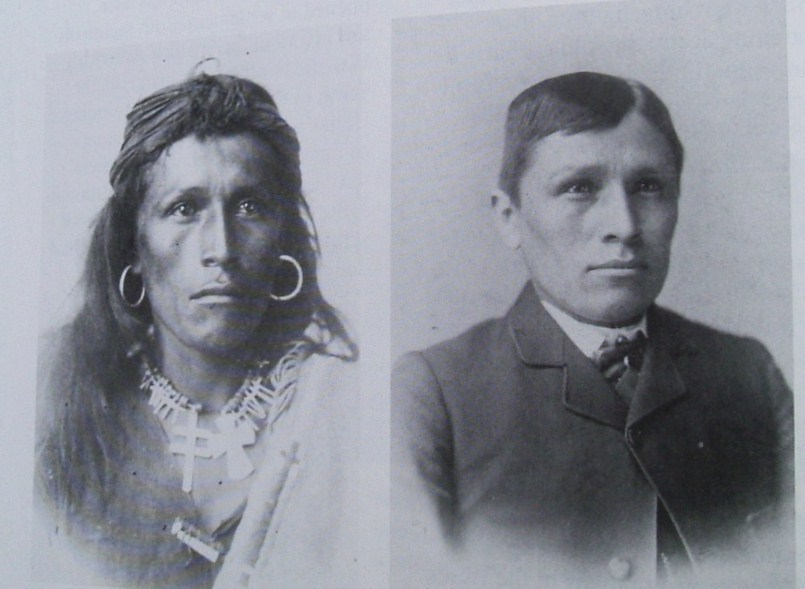
       “Kill the Indian and save the man”, a phrase to highlight the true objective of the assimilation of Natives in the United States actually was. The destruction of the Indian culture and displacement of their people wasn’t for the benefit of them but for the benefit of the white people, who were able to accede Native lands and the cultural genocide that Native children went through due to the forced boarding schools created for them. Native boarding schools stripped away important aspects to their culture such as; language, clothing, and even cut their hair which has a cultural significance to Natives.

       Zitkala-sa’s ‘Impressions of an Indian Childhood” I feel show the full effects of how these boarding schools  were trying to turn the Native children to the mainstream society and religion. Zitkala-sa’s describes herself feeling homeless and feeling lost in the world due to how she doesn’t fit in just one cultural identity, “Thus homeless and heavy-hearted, I began anew my life among strangers.”(pg25) This line in the passage reaffirms the idea that assimilation was really trying to strip the Native culture from the Native American people placing them in a borderland where they don’t feel apart of either culture.

        If the connotation of what the “American” has evolved and changed to represent the many cultures and ethnicities in the U.S. why can the government not keep up and respect the many peoples within its country. In relation to the North Dakota access pipeline and the Standing Rock peoples, the government is explicitly telling the Native American people placed in those reservations that they aren’t as important, as U.S. citizens Native Americans are of less value than white people. This conclusion comes from the fact that the government like times before has broken yet again another treaty they made with the Sioux people, in the 1851 Treaty of Fort. Laraime, and the fact that the pipeline was originally going to be put through Bismark, whose population is 94% white. Why did they move the location of the pipeline from this white city to go through sacred Native lands if the pipeline should not break? Because Native people aren’t treated of thought of as the same class of citizen as white people. Assimilation was to erase Native culture and identity, and since that didn’t wipeout every Native oppression and disregarding what sacred things they have left will have to do.

Racial Elements in The Revenant

      In today’s pop culture Alejandro Iñárntu star studded movie The Revenant was something that all of Hollywood knew was going to be a motion picture that would redefine cinematography and shed light to America’s brutal upbringing.The Revenant though set back in the 1820s underlying meaning of nature vs mankind and how manifest destiny was portrayed as going against nature and even as a racial binary. We see this in the way Alejandro shoots this film and having long shots in a scene of nature and landscape picturesquely almost like a painting.The racial binary is shown mostly through the interactions Glass has with Fitzgerald and the Europeans interactions with the Natives, but can also be analyzed with visual elements when comparing a still of the film to the painting American Progress. The comparison of these two paintings can help audience see the difference between views of manifest destiny and how it was racial and the affects to nature it has.        

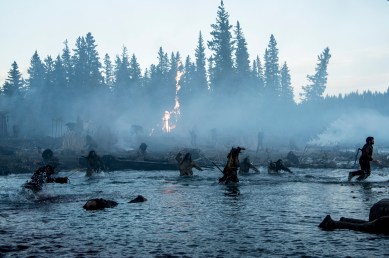
the-revenant-4b        In this scene we have the natives facing off against the Europeans trying to take the pelts that the fur traders have. This shot in the film is picturesque like so that calls for some visual analysis relating to how the racial binary of setting the Europeans against the Natives harms nature going against the peace and beauty that nature holds. In the picture viewers can see the trees in the background being illuminated, highlighting nature’s beauty, and how harmonious it is. The binary of this racial divide is shown through the flames that are setting off in the middle of the trees, showing how disruptive and chaotic this fighting is to nature. I also think it’s kind of interesting to note that in this picture everyone seems topicture-of-manifest-destiny-american-progress-2 be going to the right in a frantic way. We have Natives chasing a European man, throwing their weapon in him but viewers are able to see a completely different narrative in the painting American Progress. The people in this painting are all moving to the west representing Manifest destiny, walking over in a calm manner following an angelic figure, in a way justifying the move and saying it’s a good thing, the Natives also move in that direction but are seen moving in a more hasty way almost looking like they’re going to be trapped.
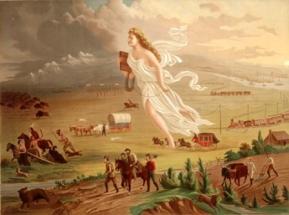
       The comparison in this picture to the one from The Revenant is one to note because the two pictures when compared to one another show the different scenarios that were taking place within the same time period. In the American progress painting we have bright hues giving the feeling of a bright future while the parts still inhabited by the natives are darker. In the still from The Revenant is dark though when shooting this movie Alejandro Iñárritu choose only to use natural lighting still doesn’t disregard the fact that this still is darker in the fighting area to show how what is happening isn’t beautiful but violent. The figures almost black give the audience the contrast of man and nature because they are being illuminated by the trees in the background but the fact that they’re still dark shows how this racial binary it is not a harmonious aspect of nature.

Pleasurable Destruction

       The sensation of pleasure humans feel when looking at… Ruins? This is called ruin porn. Why is it called this, and why isn’t it even a phrase might be someone’s first thought after hearing such a phrase, it surely was mine. So why is it a phrase used in academic language, simply because it is a way to describe the social aspect of people trying to understand an emotional feeling people get from observing ruins, and the fear of the chaos that they come from. Which is weird because ruins basically represent the death and destruction of a distant society which should be disturbing and unnerving to observe. Thinking of a time that was once there and the people and social structures, so people are receiving pleasure from looking at destruction. This makes sense to me in the world we live in today, we have tons of action movies, war movies, and superhero movies that all emphasis the destruction that occurs within those realities and they dominate the box office because people enjoy watching those things come to play on the big screen, and seeing how in the end a majority of a time from those destructions come rebirth, and a better society from the one destroyed. So in the end people who enjoy looking at ruins and partaking in seeing ruin porn, observe and learn from those fallen societies what worked and things that didn’t work, to use in their own or a new society.

       Another thing I feel like may influence the way people perceive the word ruin porn negatively is simply because of the connotation of the word porn. The negative connotation with porn goes far back in our history, and something I think can even be pulled from the bible, “But I say to you that everyone who looks at a woman with lustful intent has already committed adultery with her in his heart”(Matthew 5:28), porn is basically looking at predominantly naked women or women in an inappropriate manner, which is what is being said and looked down upon by God. We see this sense of women and nakedness being taboo in the book of Genesis with Adam and Eve. Because like Adam and Eve who were at first innocent not even recognizing their nakedness tricked into eating the fruit from the tree of knowledge of good and evil, they all of a sudden feel shameful and even like it’s a taboo. And this notion of shame and taboos I feel like is introduced and prevalent in the world from which “they created”. The thought of porn has the very close association of taboo and it goes to show with Adam and Eve that once we become knowledgeable about norms and cultures taboos are quickly picked up and recognized as so. So why is ruin porn not seen as Taboo in the academic sphere of knowledge?

       From my understanding and analysis of the words and their meanings, ruin porn is a term used in a manner not to showcase taboos of the pleasure people get from staring at ruins but how society as a whole is captivated by this phrase that represents something so negative and destructive as a way to be helpful and improve our societies. Even the recognition of how the word porn and its original connotation being negative, from something as old as the bible and now it is being used in academic language shows the progress and change in norms in our society from then to know.

CNN article “What ‘ruin porn’ tells us about ruins”