In today’s pop culture Alejandro Iñárntu star studded movie The Revenant was something that all of Hollywood knew was going to be a motion picture that would redefine cinematography and shed light to America’s brutal upbringing.The Revenant though set back in the 1820s underlying meaning of nature vs mankind and how manifest destiny was portrayed as going against nature and even as a racial binary. We see this in the way Alejandro shoots this film and having long shots in a scene of nature and landscape picturesquely almost like a painting.The racial binary is shown mostly through the interactions Glass has with Fitzgerald and the Europeans interactions with the Natives, but can also be analyzed with visual elements when comparing a still of the film to the painting American Progress. The comparison of these two paintings can help audience see the difference between views of manifest destiny and how it was racial and the affects to nature it has.
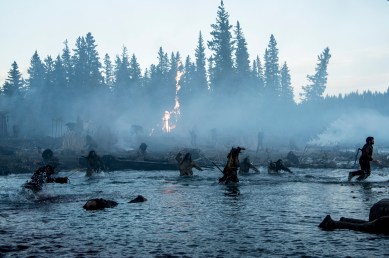 In this scene we have the natives facing off against the Europeans trying to take the pelts that the fur traders have. This shot in the film is picturesque like so that calls for some visual analysis relating to how the racial binary of setting the Europeans against the Natives harms nature going against the peace and beauty that nature holds. In the picture viewers can see the trees in the background being illuminated, highlighting nature’s beauty, and how harmonious it is. The binary of this racial divide is shown through the flames that are setting off in the middle of the trees, showing how disruptive and chaotic this fighting is to nature. I also think it’s kind of interesting to note that in this picture everyone seems to
 be going to the right in a frantic way. We have Natives chasing a European man, throwing their weapon in him but viewers are able to see a completely different narrative in the painting American Progress. The people in this painting are all moving to the west representing Manifest destiny, walking over in a calm manner following an angelic figure, in a way justifying the move and saying it’s a good thing, the Natives also move in that direction but are seen moving in a more hasty way almost looking like they’re going to be trapped.
The comparison in this picture to the one from The Revenant is one to note because the two pictures when compared to one another show the different scenarios that were taking place within the same time period. In the American progress painting we have bright hues giving the feeling of a bright future while the parts still inhabited by the natives are darker. In the still from The Revenant is dark though when shooting this movie Alejandro Iñárritu choose only to use natural lighting still doesn’t disregard the fact that this still is darker in the fighting area to show how what is happening isn’t beautiful but violent. The figures almost black give the audience the contrast of man and nature because they are being illuminated by the trees in the background but the fact that they’re still dark shows how this racial binary it is not a harmonious aspect of nature.
 Where there is ruin, there is hope.
I think your comparison of these two topics was well done as it compared the revenant being a realistic point of view of nature and migration whereas American Progress showed a fictional aspect of settlement. The analysis of the lighting in Inarritu’s shot helped better detail his vision for the film showed how racially one-sided Manifest Destiny was. The comparison helped reinforce the idea that Manifest Destiny was portraying the Natives in a negative sense while The Revenant showed what actually happened at the time. – Justin
LikeLike
Your comparison between the scene from the movie and the painting “American Progress” was extremely well done and seeing them side by side like that really emphasizes the differences in the scenes. This truly intensifies the propaganda used to get more people to come to the west, and I believe it is for that reason the writers and director of “The Revenent” decided to make their movie so violent.
LikeLike